
Freightliner and Volvo are two of the biggest names in modern American trucking. Walk through almost any major truck stop or distribution center in the United States and there is a good chance you will see both brands parked side by side.
For long-haul drivers, the comparison usually comes down to two trucks: the Freightliner Cascadia and the Volvo VNL.
Both are modern aerodynamic Class 8 tractors designed for high-mileage highway work. Both offer integrated engines and automated transmissions, large sleeper configurations, advanced safety technology, remote diagnostics, and equipment aimed at reducing fuel consumption. Both are widely used by major fleets, regional carriers, and owner-operators.
But they have different strengths.
The Freightliner Cascadia has built its reputation around low operating cost, widespread service support, fleet efficiency, and the Detroit powertrain. The current Fifth Generation Cascadia is available in day-cab and sleeper configurations up to 72 inches and uses Detroit DD13 and DD15 engines paired with Detroit DT12 automated transmissions in many configurations.
The current Volvo VNL takes a somewhat different approach. Volvo has put enormous emphasis on driver comfort, safety, aerodynamics, integrated powertrain technology, and a premium sleeper environment. The VNL family ranges from the VNL 300 day cab to the flagship VNL 860 with a 74-inch full-height sleeper.
So which is better?
For many fleets and cost-conscious owner-operators, the Cascadia may have the practical advantage because of its enormous service footprint and widespread use.
For drivers who prioritize cab comfort, steering feel, safety technology, and sleeper design, the Volvo VNL can be extremely attractive.
The correct choice depends on what you expect the truck to do.
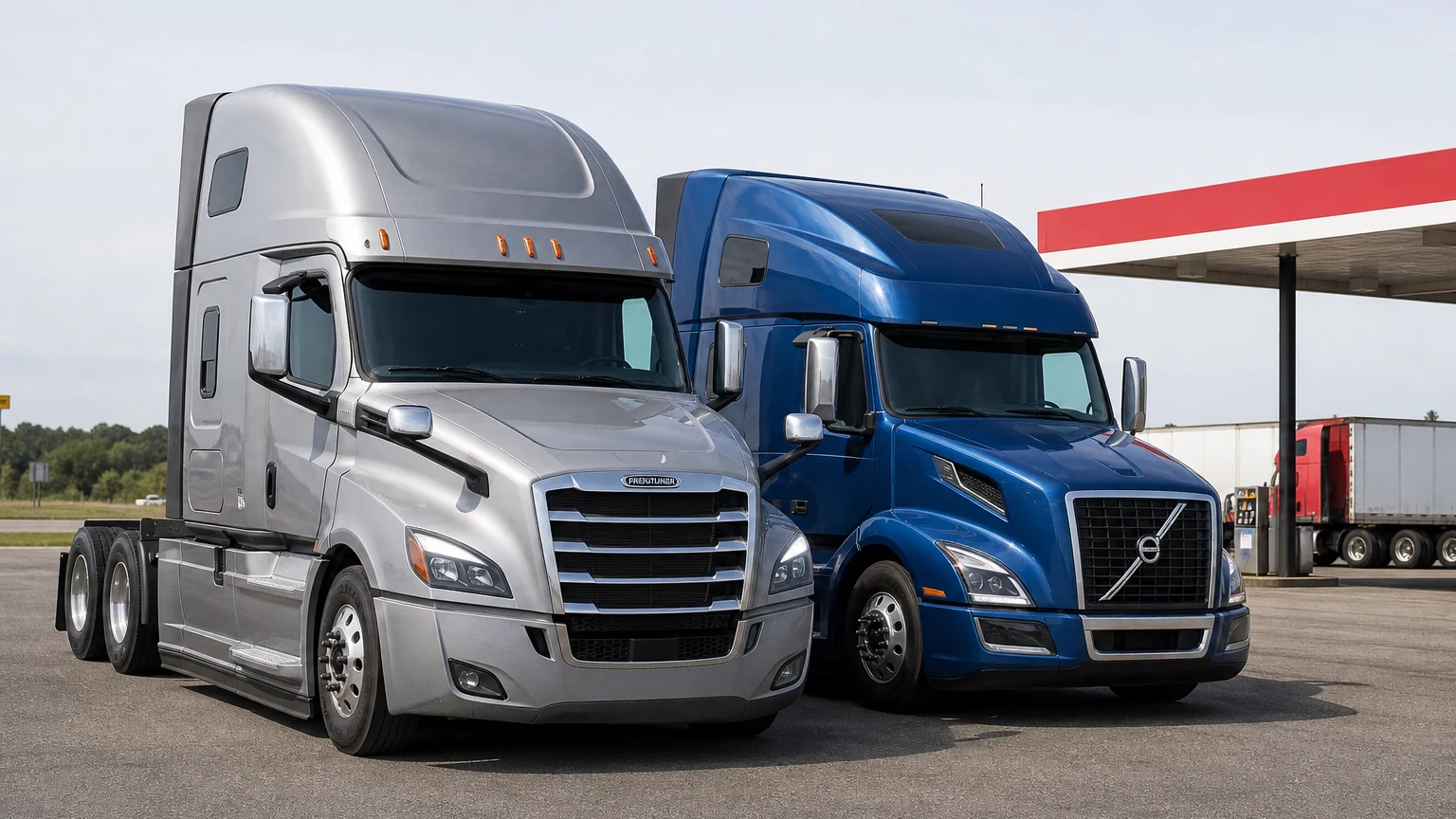
Freightliner vs. Volvo: Quick Comparison
| Category | Freightliner Cascadia | Volvo VNL |
|---|---|---|
| Manufacturer | Daimler Truck North America | Volvo Trucks / Volvo Group |
| Main OTR truck | Cascadia | VNL |
| Diesel engine focus | Detroit DD13 / DD15 | Volvo D13 |
| Main automated transmission | Detroit DT12 | Volvo I-Shift |
| Current diesel horsepower range | Up to 525 hp depending on configuration | 405–500 hp |
| Maximum listed VNL/Cascadia torque | Up to roughly 1,850 lb-ft on current Cascadia configurations | Up to 1,950 lb-ft |
| Largest primary OTR sleeper | 72-inch Raised Roof | 74-inch VNL 860 |
| Safety system | Detroit Assurance | Volvo Active Driver Assist |
| Remote diagnostics | Detroit Connect | Volvo Connect / Remote Diagnostics |
| Major strength | Service network, fleet economics, availability | Comfort, safety, integrated driver experience |
| Best choice | Depends on operation | Depends on operation |
Those specifications only tell part of the story.
The real differences become much more obvious once you spend 10 or 11 hours behind the wheel — and another 10 hours living in the sleeper.
Freightliner Cascadia vs. Volvo VNL
The fairest comparison is Cascadia vs. VNL, because both trucks are designed primarily for modern linehaul, regional, and OTR operations.
The Cascadia has become one of the defining fleet tractors in the United States. Its design is heavily focused on aerodynamics, fuel economy, ease of maintenance, safety technology, and keeping the truck productive.
The Fifth Generation Cascadia uses features such as an updated aerodynamic hood, Max Aero bumper, A-pillar deflectors, wheel-well closeouts, cab fairings, and other airflow-management components. Freightliner says the latest generation provides approximately a 1.9% fuel-efficiency improvement over the previous Cascadia, primarily through aerodynamic changes.
The Volvo VNL underwent an even larger redesign. Volvo describes the current VNL as a new-generation platform rather than simply an update to the previous truck. Its curved windshield, wedge-shaped cab, fairing extensions, underbody airflow treatment, and powertrain improvements contribute to a manufacturer-claimed up to 10% improvement in fuel efficiency compared with the previous VNL generation.
Those percentages should not be used to conclude that a Volvo automatically gets 8% better MPG than a Cascadia.
The two manufacturers are comparing their trucks against different previous models under different test conditions.
The meaningful conclusion is that both companies have made aerodynamics and fuel economy major priorities.
The Biggest Difference You Notice From the Driver's Seat
Many drivers who have operated both brands will tell you that the difference becomes more noticeable inside the cab than outside it.
Freightliner has traditionally designed the Cascadia around practical fleet operation. Controls are arranged to be easy to understand, visibility is strong, storage is useful, and the truck is designed so drivers can quickly move between different Cascadias without having to relearn the entire cab.
The Fifth Generation truck includes an interactive touchscreen, updated HVAC, multiple interior configurations, improved seating options, and redesigned sleeper features. Freightliner also introduced a telescoping upper-bunk ladder designed to improve access in double-bunk configurations.
Volvo approaches the driver environment with more of a premium automotive influence.
The current VNL uses a digital information display, stalk-mounted transmission controls, infotainment system, push-button and remote-start functionality, extensive steering-wheel controls, and an interior designed around keeping frequently used functions close to the driver.
That does not automatically make Volvo better.
Some drivers prefer the straightforward Cascadia layout because they have spent years operating Freightliners and can reach almost every control without thinking.
Others immediately prefer the Volvo because of its driving position and more integrated interior.
For a company driver who spends months in the same assigned truck, these seemingly small differences can become extremely important.
Which Has the Better Sleeper?
For OTR drivers, this may matter more than horsepower.
You are not simply driving the tractor.
You may be living inside it for two or three weeks at a time.
Freightliner offers the Cascadia with several sleeper configurations, including 48-, 60-, and 72-inch sleepers. Both mid-roof and raised-roof options are available on applicable configurations.
The 72-inch Raised Roof is the configuration most likely to interest full-time OTR drivers. It provides substantial storage and room for common sleeper equipment such as a refrigerator, microwave, television, inverter, and double-bunk setup depending on specification.
Volvo offers a broader named range of sleeper configurations.
The current lineup includes:
- VNL 440 — 42-inch mid-roof sleeper
- VNL 640 — 62-inch mid-roof sleeper
- VNL 660 — 62-inch full-height sleeper
- VNL 840 — 74-inch mid-roof sleeper
- VNL 860 — 74-inch full-height sleeper
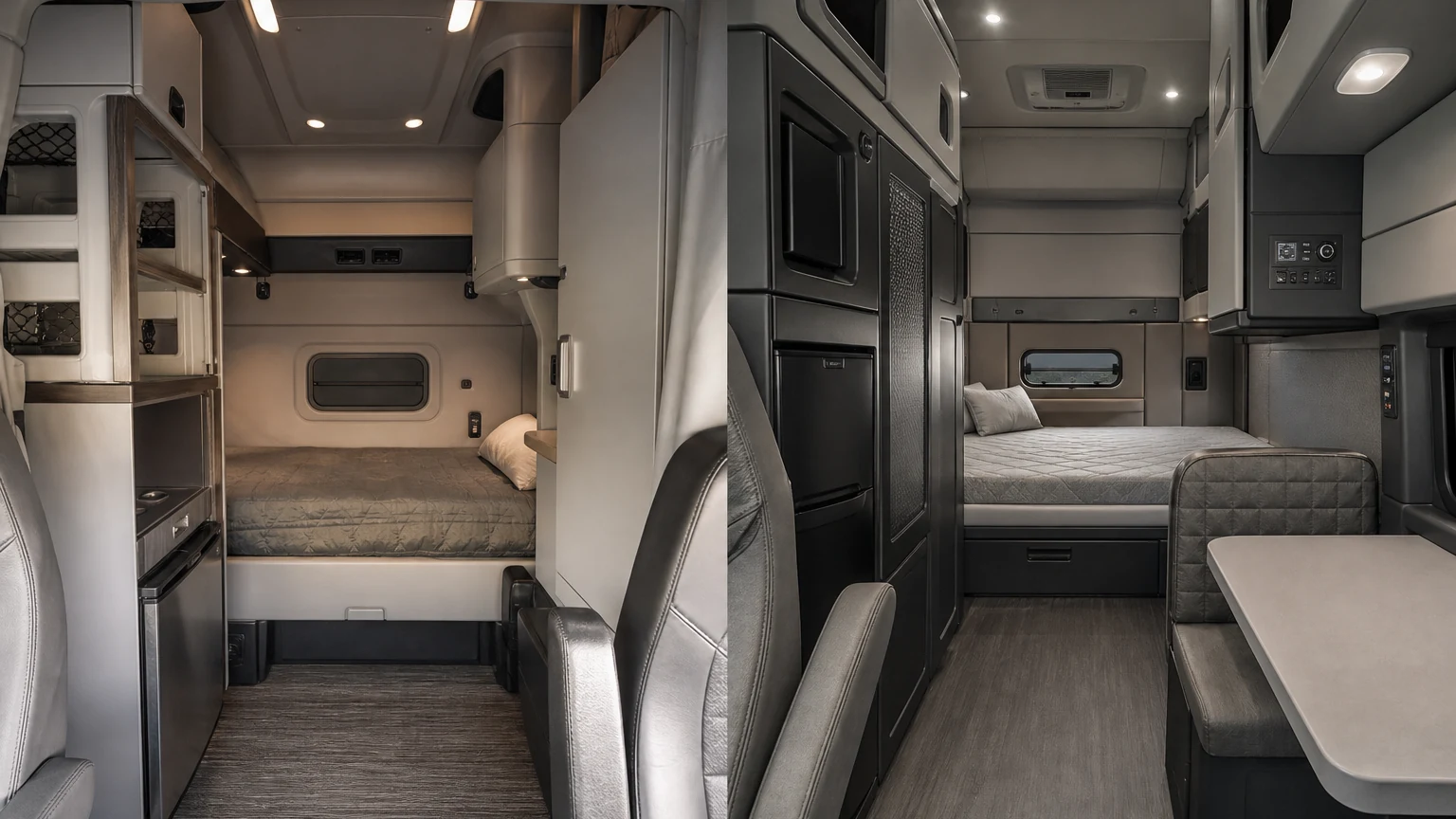
The VNL 860 is Volvo's flagship OTR sleeper. Its 74-inch sleeper can be configured with features such as a large mattress, reclining bunk or pull-down bunk arrangement, substantial storage, and work/dining space depending on the selected package.
For pure sleeper comfort, many drivers may prefer the Volvo VNL 860.
But sleeper dimensions alone do not determine comfort.
A good 72-inch Cascadia sleeper may feel better to one driver because the storage layout matches their equipment. Another driver may prefer the wider-feeling living environment and furniture arrangement of a VNL 860.
The only reliable way to decide is to spend time inside both.
Sit on the bunk.
Stand between the seats.
Open the storage cabinets.
Imagine where your clothes, food, microwave, coffee maker, laptop, shoes, tools, bedding, water, and laundry will go.
A sleeper that looks enormous in a promotional photo can become much smaller after you move into it.
Detroit DD15 vs. Volvo D13
The powertrain is one of the biggest mechanical differences between the two brands.
Freightliner's flagship highway diesel combination is closely associated with the Detroit DD15 and Detroit DT12 automated transmission.
Current Fifth Generation Cascadia specifications list Detroit DD13 and DD15 engines, with the current DD15 available in ratings from roughly 425 to 505 horsepower and 1,550 to 1,850 lb-ft of torque. Cascadia configurations can also use the lighter DD13 for applications where its size and output make sense.
Volvo centers the VNL around its D13.
The current D13 range for the VNL is listed at 405 to 500 horsepower and 1,650 to 1,950 lb-ft of torque.
That does not mean the Volvo is automatically stronger because its maximum torque figure is higher.
Engine rating is only one part of how a truck performs.
Rear axle ratio, transmission programming, vehicle weight, terrain, gearing, engine calibration, trailer, road speed, and load all affect how the tractor feels.
For normal 80,000-pound dry-van and reefer service, either engine platform can provide more than enough power when correctly specified.
Drivers who regularly pull heavy loads through mountains may prefer a higher-output configuration, while fleets operating relatively flat linehaul routes may prioritize lower fuel consumption over maximum horsepower.
Detroit DT12 vs. Volvo I-Shift
Both manufacturers strongly favor automated manual transmissions.
Freightliner's integrated Detroit powertrain commonly pairs the DD13 or DD15 with the Detroit DT12, a 12-speed automated manual transmission.
Volvo pairs the D13 with the Volvo I-Shift, another 12-speed automated manual transmission. The new VNL also offers advanced torque-management packages including I-Torque configurations intended to work with very low rear axle ratios.
Both systems are designed to remove the need for traditional manual shifting while allowing software to choose gears according to load, road grade, speed, and engine operating conditions.
For company drivers, the practical difference is often small.
Put the transmission into Drive and go.
For an owner-operator, however, the integrated powertrain can have a major effect on fuel economy and maintenance strategy.
A Detroit engine, Detroit transmission, and Detroit axles allow Freightliner to create a closely integrated system.
Volvo follows the same philosophy with the Volvo D13, I-Shift, and Volvo drivetrain technology.
In both cases, the manufacturer controls far more of the complete powertrain than truck makers did decades ago.
Which Truck Has More Power?
Looking only at current published figures, the Volvo D13 reaches up to approximately 500 horsepower and 1,950 lb-ft of torque, while the current Cascadia diesel specifications reach up to about 525 horsepower depending on engine configuration, with current listed torque figures around 1,850 lb-ft in the main Fifth Generation specification set.
But the difference is not particularly important for most ordinary OTR drivers.
A truck pulling a dry van at 75,000 pounds does not necessarily become more profitable because it has another 25 horsepower.
Higher power can be useful when climbing steep grades or hauling heavy freight, but it can also come with higher fuel consumption depending on specification and driving style.
Instead of asking:
"Which one has more horsepower?"
an owner-operator should ask:
"Which engine, gearing, and transmission combination is most efficient for my freight and routes?"
That is the more important business question.
Which Gets Better Fuel Economy?
This is one of the hardest categories to declare a winner.
Volvo says the redesigned VNL can deliver up to 10% greater fuel efficiency than the previous VNL generation through aerodynamic and powertrain improvements.
Freightliner says the Fifth Generation Cascadia improves fuel economy by approximately 1.9% over the immediately preceding generation, with aerodynamic improvements being an important contributor. Freightliner also notes that the Cascadia platform has achieved more than a 35% fuel-economy improvement across its generations since 2007.
Again, those manufacturer percentages cannot be directly compared.
A real Cascadia and VNL running the same lane may produce very similar MPG.
The result will depend on far more than the badge.
Important factors include engine rating, rear axle ratio, tractor weight, trailer aerodynamics, trailer gap, cargo weight, tires, average speed, idle time, terrain, weather, and driver behavior.
An efficient driver in a well-spec'd Cascadia can easily outperform a poorly configured or aggressively driven Volvo.
And the reverse can happen just as easily.
For an owner-operator, the smartest way to compare them is to obtain real fuel data from similarly configured trucks operating the same kind of freight.
A one-MPG difference can be worth thousands of dollars annually.
A tiny difference measured during one short test drive means almost nothing.
Aerodynamics: Both Trucks Are Built Around Airflow
Modern highway trucks look the way they do for a reason.
At interstate speeds, aerodynamic drag becomes one of the largest factors affecting fuel use.
The Fifth Generation Cascadia incorporates a redesigned hood, grille, bumper, wheel-well closeouts, A-pillar deflectors, fairings, and other features intended to manage airflow around the tractor and toward the trailer.
The VNL takes an equally aggressive approach.
Volvo uses a curved windshield, sloped A-pillars, wedge-shaped cab, cab fairing extensions, low ground effects, wheel closeouts, and FlowBelow components around the drive wheels.
This creates an interesting difference from the Peterbilt-versus-Kenworth debate.
Neither the Cascadia nor the VNL is trying to look like a traditional long-hood show truck.
They are both fundamentally aerodynamic working tractors.
If you want a huge square grille, long hood, exposed air cleaners, and stacks behind the cab, neither truck is really designed around that philosophy.
Their job is to move freight efficiently.
Which One Rides Better?
Ride quality is highly subjective, but Volvo has developed a particularly strong reputation around driver comfort.
Part of that comes from cab design and seating, and part comes from features such as Volvo Dynamic Steering.
Volvo Dynamic Steering uses electric assistance combined with the hydraulic steering system to reduce steering effort and filter some road input. The current VNL can also integrate VDS with lane and oversteer assistance depending on specification.
For drivers spending ten hours behind the wheel, reducing steering effort can make the truck feel less tiring.
The Cascadia is also designed for long-distance comfort and can be equipped with premium seats, air suspension, improved insulation, and advanced driver-assistance functions.
However, ride quality depends on far more than the badge.
A truck's wheelbase, steer axle, suspension, tires, seat, fifth-wheel location, trailer, and cargo weight all affect the ride.
A long-wheelbase Volvo may ride differently from a short fleet Cascadia.
A lightly loaded tractor may feel different from the same truck at 78,000 pounds.
So while Volvo may have an edge in perceived steering refinement, drivers should test comparable specifications rather than comparing one premium VNL 860 with a basic fleet-spec Cascadia.
Which Has the Better Driving Position?
Volvo has traditionally placed a great deal of attention on driver ergonomics.
The new VNL continues that approach. The dashboard wraps around the driver, frequently used controls are positioned close to the steering wheel, transmission selection has moved to the steering-column stalk, and digital displays provide information without requiring the driver to look far away from the road.
The Cascadia is also designed around visibility and straightforward controls. The Fifth Generation has a redesigned hood intended to improve forward visibility, a wrap-around dashboard, steering-wheel controls, and an interactive touchscreen.
Which is better depends heavily on the driver's body size and preferences.
Tall drivers may prefer one seat and steering-wheel relationship.
Shorter drivers may have better visibility in another.
Some drivers like controls angled toward them.
Others prefer a simpler flat dashboard.
If you are choosing a truck you intend to keep for several years, spend more than five minutes in the driver's seat before making the decision.
Safety: Volvo's Strongest Category
Safety is one area where Volvo has deliberately tried to distinguish the VNL.
The current truck uses the Volvo Active Safety Platform, with features that can include adaptive cruise control with stop-and-go capability, forward collision mitigation, automatic emergency braking, blind-spot detection, lane-departure support, pedestrian detection, Volvo Dynamic Steering integration, and road-sign recognition depending on configuration.
The VNL also uses a high-strength-steel cab.
Current new VNL production includes integrated side-curtain airbags as standard equipment, while Volvo's E-Call system can automatically contact emergency services and transmit the truck's location after a qualifying rollover or airbag deployment when cellular service is available.
Freightliner is not far behind technologically.
The Fifth Generation Cascadia uses the Detroit Assurance with Active Brake Assist 6 safety suite. Standard and optional features vary by configuration but can include active braking, lane assistance, traffic-sign information, electronic stability functions, MirrorCam, and additional collision-mitigation technology.
The truck also introduced an Intelligent Braking Control System, electronic parking-brake functionality, improved LED headlights, and expanded safety integration.
Both are highly advanced trucks.
But if safety technology is one of your biggest purchasing priorities, Volvo has a particularly compelling package, especially when equipped with the more advanced driver-assistance options.
Camera Mirrors and Traditional Mirrors
Digital camera mirror systems are becoming increasingly common on modern tractors.
Freightliner's MirrorCam uses exterior cameras and displays mounted inside the cab. Freightliner says the system increases side visibility and can reduce driver fatigue while also contributing to aerodynamic efficiency.
The Volvo VNL also offers advanced camera-based visibility technology depending on configuration.
Some drivers love these systems.
The screen can maintain a useful view during rain, darkness, trailer turns, and certain backing situations.
Other drivers strongly prefer conventional glass mirrors because they are familiar, mechanically simple, and continue working without electronic displays.
If you are buying rather than simply driving a company truck, think carefully about your preference before ordering expensive camera systems.
The technology can be excellent.
But you are the person who will use it every day.
Which Is Easier to Repair on the Road?
This is one of Freightliner's biggest practical advantages.
Freightliner operates an extremely large service and parts network in North America. Its current dealer locator advertises more than 700 service locations, while the Cascadia product page describes a large dealership support network dedicated to the model.
Volvo also has a substantial network. Volvo currently says it has more than 430 dealer locations in North America, supported by its Uptime network, remote diagnostics, ASIST repair-management system, and Volvo Action Service.
Both networks are large enough to support nationwide trucking.
But because Cascadias are so common in fleet service, parts familiarity and technician experience can be particularly widespread.
For a large fleet, that matters.
If you operate 500 nearly identical Cascadias, your own maintenance department becomes extremely familiar with the platform. Parts inventory can be standardized, technicians see the same problems repeatedly, and replacement tractors may already be available when one truck breaks down.
An owner-operator should look at the issue more locally.
If there is an excellent Volvo dealer 15 minutes from your house and your nearest Freightliner shop has a poor reputation, the national network numbers are much less important.
Investigate the dealers you will actually use.
Remote Diagnostics and Connectivity
Modern trucks often know that something is failing before the driver fully understands what is happening.
Freightliner uses Detroit Connect, which provides remote diagnostics, fleet information, safety-event data, and over-the-air programming capabilities. Freightliner says fleets can remotely make numerous engine-parameter changes through the system.
Volvo uses Volvo Connect, together with Remote Diagnostics, Remote Programming, ASIST, and related uptime services. The system can share fault information with the dealer before the truck arrives, allowing the service location to begin evaluating the repair earlier.
For a company driver, much of this technology operates in the background.
For a fleet manager or owner-operator, it can be extremely valuable.
A warning light 600 miles from home may represent anything from a minor sensor issue to a problem that could damage the engine.
Remote diagnostics can help determine whether the driver should continue, visit a dealer soon, or stop immediately.
Reducing unnecessary downtime can be worth far more than a small difference in purchase price.
Which Is More Reliable?
This is where internet arguments become less useful.
You will find drivers who swear that the DD15 is the best modern heavy-duty engine ever made.
You will find other drivers who say they would only own a Volvo D13.
You will also find drivers who have experienced expensive failures with both.
Modern Class 8 reliability depends on much more than the logo.
The engine matters.
The aftertreatment system matters.
The transmission matters.
Maintenance history matters.
Idle hours matter.
Previous driver behavior matters.
Software matters.
The duty cycle matters.
A Cascadia with 700,000 well-maintained highway miles may be a much better purchase than a neglected 450,000-mile Volvo.
The reverse is equally possible.
If you are buying used, the individual truck is far more important than general brand reputation.
Obtain maintenance records.
Check engine fault history.
Inspect the emissions system.
Check for oil and coolant consumption.
Test the transmission.
Inspect the differential, suspension, brakes, wheel ends, HVAC, electrical systems, and sleeper equipment.
A brand name does not repair a neglected truck.
Maintenance: Detroit Integration vs. Volvo Integration
Both trucks are increasingly built as integrated systems.
That has advantages.
A Cascadia with a Detroit engine, DT12 transmission, Detroit axles, Detroit Assurance, and Detroit Connect allows many major systems to communicate within one manufacturer's ecosystem.
Volvo does the same with the D13, I-Shift, Volvo safety systems, Volvo Dynamic Steering, and Volvo Connect.
Integration can improve fuel economy, diagnostics, transmission behavior, and safety-system performance.
But it can also make modern trucks more dependent on manufacturer-specific diagnostic tools and trained technicians.
Twenty-five years ago, a mechanically inclined owner-operator could solve a surprising number of problems with ordinary tools.
Today's truck may have an engine fault, transmission logic issue, NOx-sensor code, radar calibration problem, and software update all connected to each other.
That is not unique to Volvo or Freightliner.
It is simply the reality of modern Class 8 trucks.
Which Is Better for a Company Driver?
For a company driver, the decision is usually simpler because you are not paying the repair bills.
Your priorities are more likely to be:
- Seat comfort
- Ride quality
- Sleeper space
- HVAC
- Refrigerator
- Storage
- Noise
- Steering
- Visibility
- Safety technology
In those areas, Volvo can be particularly appealing.
The VNL 860 is clearly designed for drivers who spend significant time living in the truck. Its large sleeper, integrated storage, work area, digital controls, and safety technology make it a strong OTR platform.
Volvo Dynamic Steering can also be a meaningful comfort feature for high-mileage drivers.
But a well-equipped Cascadia is also an excellent company-driver truck.
The bigger difference may be how your employer specs the tractor.
A stripped-down VNL with no refrigerator and a basic sleeper can be less comfortable than a fully equipped Cascadia with upgraded seats, auxiliary HVAC, large inverter, refrigerator, and good mattress.
The badge does not tell you how the fleet ordered the truck.
Which Is Better for an Owner-Operator?
The calculation changes significantly when the driver owns the truck.
Comfort still matters, but now so do:
Purchase price.
Fuel economy.
Dealer access.
Parts availability.
Downtime.
Warranty.
Resale value.
Maintenance cost.
For many first-time owner-operators, the Freightliner Cascadia may be the more conservative business choice.
Its large service footprint and widespread use can make it easier to find shops familiar with the truck. A huge used market also gives buyers many trucks to compare before purchasing.
That does not make the Volvo a poor owner-operator truck.
A VNL can be an excellent choice for someone who spends weeks on the road and values comfort enough to pay for it. The D13/I-Shift combination is designed around fuel-efficient highway operation, Volvo offers strong remote-diagnostics support, and the VNL has a highly developed safety package.
The best owner-operator choice may ultimately come down to dealer support.
An excellent local Volvo dealership can make a Volvo more attractive.
A strong Freightliner dealer with fast parts availability can make the Cascadia the obvious choice.
The truck needs to make money.
A beautiful sleeper does not help if the tractor spends ten days waiting for a repair.
Which Is Better for Team Drivers?
Team drivers create a particularly demanding use case.
Two people need to store clothing, food, bedding, personal items, electronics, and work equipment inside the same tractor.
And one person may be sleeping while the other drives.
The VNL 860 can be especially attractive for teams because of its 74-inch full-height sleeper and available bunk arrangements. Volvo specifically designed larger VNL sleepers with team operations in mind.
The 72-inch Cascadia Raised Roof also supports double-bunk configurations, and the current generation includes a telescoping ladder intended to make the upper bunk easier to access.
For teams, however, actual sleeper layout matters more than a two-inch difference in advertised sleeper length.
Two drivers should physically inspect both trucks.
Can one person get into the upper bunk without waking the other?
Is there enough refrigerator space?
Where will both drivers keep clothes?
Can one person work at a table while the other sleeps?
Those details determine whether a team sleeper feels large or cramped after several weeks.
Which Is Better for Local and Regional Work?
The comparison is not limited to giant OTR sleepers.
The Cascadia can be ordered as a day cab and with smaller sleepers for regional operations.
Volvo offers the VNL 300 day cab, VNL 440 with a 42-inch sleeper, and several intermediate sleeper configurations.
For regional work where the driver spends only one or two nights away from home, a smaller sleeper can reduce weight and wheelbase while still providing a legal and comfortable place to rest.
A huge VNL 860 or 72-inch Cascadia may be unnecessary if the truck spends most of its life making short runs between terminals.
Fleet specifications should match the job.
Buying the largest sleeper simply because it looks impressive adds weight and cost that may not create additional revenue.
Visibility and Maneuverability
Both trucks use sloped aerodynamic hoods designed to improve forward visibility compared with traditional long-hood tractors.
That makes them useful in warehouses, truck stops, urban routes, and congested distribution centers.
Volvo has put significant emphasis on visibility and maneuverability throughout the VNL design, while Freightliner lists steering configurations allowing up to a 50-degree wheel cut on applicable Cascadia setups.
Actual turning radius depends on wheelbase, axle, tire, and chassis specification.
For new drivers, both trucks are generally easier to see around than a traditional long-hood tractor such as a Peterbilt 589 or Kenworth W990.
That can make backing and tight customer locations less intimidating.
Which Looks Better?
This one is entirely personal.
The Cascadia has a practical, unmistakably American fleet-truck appearance. The Fifth Generation has sharpened the lighting and front-end design, but the overall shape remains clearly recognizable as a Cascadia.
The new Volvo VNL looks much more dramatic than the previous generation.
Its large Volvo grille, sharply angled lighting, steeply curved windshield, and sculpted body give it a distinctly modern appearance.
Some drivers love it.
Others prefer the more familiar look of the Freightliner.
For a company driver, styling probably should not matter much.
For an owner-operator who may spend $150,000, $180,000, $200,000 or more depending on specification and market conditions, wanting a truck you actually like is perfectly reasonable.
Just remember that appearance does not reduce the monthly payment.
What About Used Freightliners and Volvos?
The used market changes the comparison significantly.
There are enormous numbers of used Cascadias available because they are so common in large fleets.
That creates choice.
A buyer can compare model years, mileage, engines, sleepers, gear ratios, maintenance history, and prices across many trucks.
But former fleet trucks need to be evaluated carefully.
A low purchase price does not automatically make a high-mileage tractor a bargain.
Volvos are also widely available used, particularly former fleet VNLs.
With either brand, maintenance history should carry more weight than appearance.
Pay particular attention to:
Engine condition.
Aftertreatment history.
Idle hours.
Transmission behavior.
Oil consumption.
Coolant loss.
Repeated fault codes.
Previous major repairs.
Tire and brake condition.
Differentials.
Electrical problems.
HVAC.
Sleeper equipment.
A $10,000 cheaper truck can become the more expensive choice within one month if it immediately needs a DPF system, injectors, turbocharger, or transmission work.
Is Freightliner Cheaper Than Volvo?
There is no useful universal answer because Class 8 truck pricing depends heavily on specification.
A basic Cascadia day cab and a fully equipped Cascadia sleeper are completely different purchases.
The same is true between a Volvo VNL 300 and VNL 860 Ultimate.
Engine configuration, sleeper, safety systems, batteries, HVAC, fuel capacity, interior trim, axles, tires, electronics, and warranties can all change the final price substantially.
Instead of comparing advertised starting prices, compare two trucks configured for the same job.
Then estimate the total ownership cost.
If one truck is $10,000 cheaper but uses more fuel or experiences more downtime in your operation, the initial savings may disappear quickly.
Likewise, paying significantly more for equipment that does not help your operation may not be justified.
Freightliner Advantages
The Cascadia's strongest argument is practicality.
It is enormously common, supported by a very large service network, and built around a well-established Detroit powertrain.
For fleets, that can simplify technician training, parts inventory, driver familiarity, and replacement-equipment planning.
For owner-operators, the large number of trucks and service locations can make it easier to find equipment, parts, repairs, and used components.
The Cascadia is also highly focused on fuel economy and total cost of ownership.
A driver who simply wants a truck that can efficiently haul dry-van or reefer freight across the country may not need anything more complicated.
Volvo Advantages
Volvo's biggest strength is the complete driver experience.
The VNL combines a very refined cab, large sleeper options, integrated D13/I-Shift powertrain, sophisticated steering technology, strong aerodynamics, remote connectivity, and one of the most comprehensive safety packages available in a North American tractor.
For drivers spending weeks at a time on the road, comfort is not a luxury in the same sense as it is in a passenger car.
A better seat, quieter cab, easier steering, better sleeper layout, and more usable storage can affect the driver every single day.
Volvo also makes safety a particularly visible part of the truck's design, from its high-strength-steel cab to its current driver-assistance and airbag technology.
Freightliner vs. Volvo: Which Is Better for New Drivers?
A new CDL driver should not worry too much about choosing a brand.
If a good carrier offers you a well-maintained Cascadia with proper training and another carrier offers a poorly maintained Volvo, choose the better company.
The opposite applies too.
New drivers should prioritize:
Good training.
Safe equipment.
Reliable maintenance.
Reasonable dispatch.
Realistic home time.
Fair pay.
Good safety culture.
The truck brand comes after those things.
Both Cascadias and VNLs are widely used as training and fleet tractors because their short aerodynamic hoods provide good visibility and they are commonly equipped with automated transmissions.
Either can be an excellent first truck.
Freightliner vs. Volvo: Which Is Better for OTR?
For OTR work, the competition is extremely close.
Choose the Freightliner Cascadia if your biggest priorities are a huge support network, familiar equipment, widespread parts availability, Detroit powertrain integration, and strong fleet-oriented economics.
Choose the Volvo VNL if your biggest priorities are driver comfort, sleeper design, steering refinement, advanced safety systems, and an integrated D13/I-Shift driving experience.
For a company driver, I would put more emphasis on how the specific truck is equipped.
For an owner-operator, I would put more emphasis on dealer support and total operating cost.
A Volvo may be the better truck for your body and lifestyle.
A Cascadia may be the better truck for your business.
Or the opposite may be true depending on the dealers and freight you run.
Frequently Asked Questions
Is Volvo Better Than Freightliner?
Not universally. Volvo has major strengths in driver comfort, sleeper design, steering technology, and safety. Freightliner has major strengths in service availability, fleet support, widespread parts access, and a proven integrated Detroit powertrain.
Is the Volvo VNL More Comfortable Than the Cascadia?
Many drivers may prefer the VNL's cab and sleeper design, particularly the VNL 860, but comfort is subjective. A well-equipped Cascadia can also be extremely comfortable for long-haul operations.
Which Has the Bigger Sleeper?
The current Volvo VNL 860 uses a 74-inch full-height sleeper, while the largest standard Cascadia sleeper configuration listed by Freightliner is 72 inches. Interior layout matters more than the two-inch nominal difference.
Which Engine Is Better: Detroit DD15 or Volvo D13?
Both are major modern heavy-duty diesel engines. The DD15 is closely integrated with the Cascadia and DT12 transmission, while the D13 is integrated with Volvo's I-Shift. Maintenance history, specification, dealer support, and duty cycle matter more than simply choosing one name.
Which Has the Better Transmission?
Both the Detroit DT12 and Volvo I-Shift are highly developed automated manual transmissions. Drivers may notice differences in shifting behavior, but either can work very well when properly configured and maintained.
Which Truck Is More Fuel Efficient?
There is no universal real-world winner. Both manufacturers have invested heavily in aerodynamics and integrated powertrains. Fuel economy depends on the truck's specification, load, road speed, weather, terrain, trailer, tires, and driver behavior.
Which Is Easier to Find Parts for?
Freightliner's very large North American service footprint and the huge number of Cascadias in operation can be an advantage for parts and service access. Volvo also maintains a large nationwide dealer and uptime network.
Is Volvo Safer Than Freightliner?
Both offer sophisticated active safety systems. Volvo places particularly strong emphasis on safety and currently includes technology such as its high-strength-steel cab, active safety systems, E-Call, and standard side-curtain airbags on new VNL production. Freightliner offers Detroit Assurance, Active Brake Assist, electronic braking features, MirrorCam, and other advanced systems.
Which Is Better for an Owner-Operator?
The Cascadia can be particularly attractive to cost-conscious owner-operators because of service availability and its large support ecosystem. The Volvo can be attractive to drivers who prioritize comfort, safety, and the D13/I-Shift platform. Dealer quality and the individual truck should strongly influence the decision.
Which Is Better for a Company Driver?
The Volvo may have an advantage for drivers who prioritize comfort, while a Cascadia can be equally good when well equipped. The carrier's maintenance quality and actual specification of the truck usually matter more than the brand name.
Final Thoughts
The Freightliner Cascadia and Volvo VNL are two of the strongest modern OTR tractors available to American truck drivers, but they approach the job from slightly different directions.
Freightliner focuses heavily on fleet economics, efficiency, uptime, serviceability, and the integrated Detroit ecosystem. The Cascadia is extremely common, widely supported, and available in configurations ranging from day cabs to 72-inch raised-roof sleepers.
Volvo puts extraordinary emphasis on the driver. The current VNL combines a redesigned aerodynamic cab with the D13 and I-Shift powertrain, advanced safety systems, Volvo Dynamic Steering, sophisticated connectivity, and sleepers reaching 74 inches in the flagship VNL 860.
So which is better?
For a fleet or owner-operator who prioritizes service availability, parts access, and straightforward business economics, the Freightliner Cascadia may have the advantage.
For a driver who prioritizes comfort, safety, steering feel, and sleeper quality, the Volvo VNL may be more appealing.
But neither brand is automatically more reliable, more profitable, or better for every trucker.
Compare the actual truck.
Compare its engine and transmission.
Compare fuel economy.
Sit in the driver's seat.
Spend time in the sleeper.
Check the dealer network where you actually run.
Review maintenance and warranty costs.
And if you are buying used, investigate the individual truck's history carefully.
The best semi-truck is not the one that wins the most arguments at the truck stop.
It is the one that keeps you comfortable, keeps moving, and makes sense for the work you actually do.
