
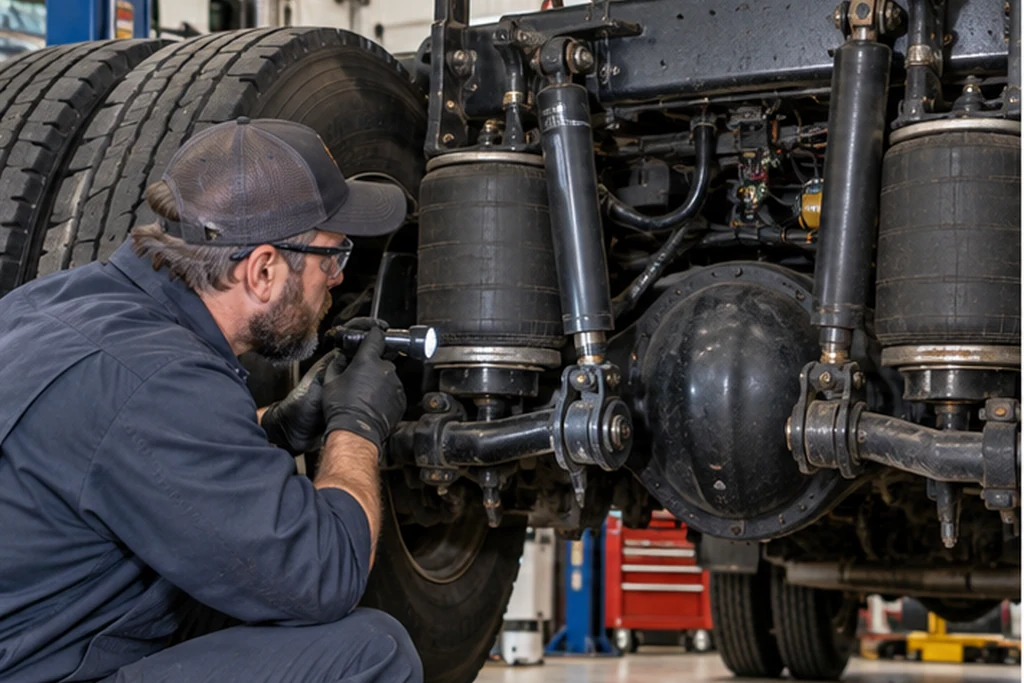
A semi-truck suspension is designed to handle heavy loads, rough pavement, constant vibration, and thousands of miles of operation. It will never be completely silent, but a new squeak, clunk, rattle, hiss, or banging sound should not be ignored. Noise is often one of the first signs that a suspension component is loose, worn, damaged, dry, or no longer holding the vehicle at the correct ride height.
The challenge is identifying where the sound actually comes from. Noise from a wheel bearing, brake component, fifth wheel, cab mount, exhaust bracket, or cargo securement system can travel through the frame and sound like a suspension problem. A driver may hear a clunk beneath the seat even when the defective component is several feet away.
The type of noise, its location, and the conditions under which it appears can help a technician find the cause. Notice whether it happens during turns, braking, acceleration, trailer loading, or travel over uneven pavement. You should also determine whether the sound comes from the tractor, trailer, steer axle, drive axles, or cab suspension.
Federal safety rules require commercial-vehicle suspension components to be structurally sound and in safe working order. The FMCSA suspension-system guidance covers axles, springs, suspension hardware, and other important components. A suspension noise may begin as an annoyance, but it can eventually affect tire wear, alignment, braking stability, ride quality, and vehicle control.
What Does a Truck Suspension Do?
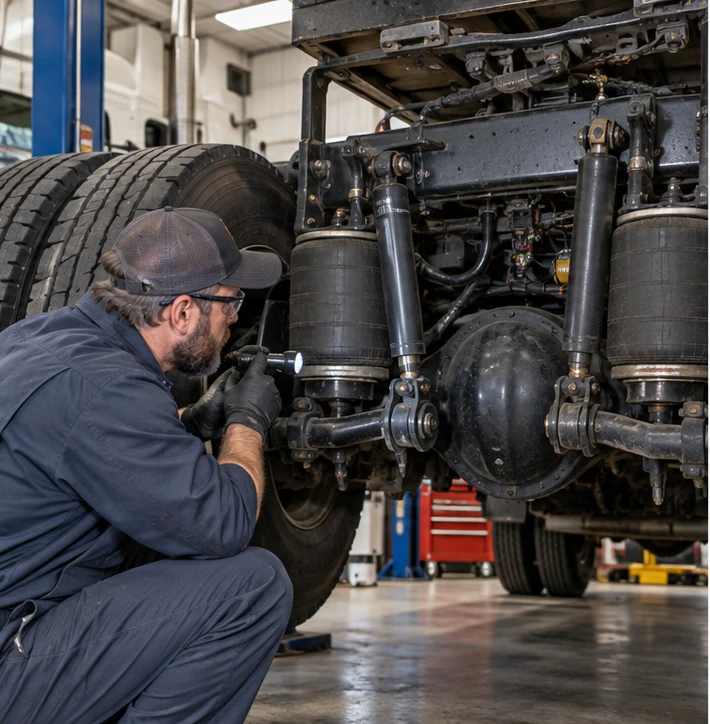
The suspension supports the weight of the tractor, trailer, cargo, and occupants while keeping the tires in consistent contact with the road. It also controls axle movement and absorbs some of the energy created by bumps, potholes, braking, and acceleration.
Many modern highway tractors and trailers use air suspension. Flexible air springs, commonly called airbags, support the vehicle using compressed air. A height-control valve adds or releases air to maintain the specified ride height as the load changes. Shock absorbers control excessive movement, while torque rods, bushings, hangers, and other structural parts keep the axles properly positioned.
Other trucks and trailers use leaf springs or a combination of mechanical and air-suspension components. Leaf springs carry the load and flex as the vehicle moves over the road. They are held in position by hangers, shackles, pins, bushings, U-bolts, and related hardware.
Every connection experiences movement and vibration. Once a bushing wears, a fastener loosens, or a shock absorber loses control, metal parts can begin moving farther than intended. That movement frequently produces noise before the driver notices a significant change in handling.
Squeaking Usually Points to Friction or Worn Bushings
A squeaking or creaking sound often develops when two components move against each other without the proper separation or lubrication. Suspension bushings are a common source because they are designed to isolate vibration while allowing controlled movement.
As a rubber or elastomeric bushing ages, it may harden, crack, separate, or wear away. The connected components can then shift under load. A worn torque-rod bushing, spring-eye bushing, shackle bushing, or cab-suspension bushing may squeak whenever the truck accelerates, brakes, turns, or crosses uneven pavement.
Leaf-spring suspensions can also produce noise as the spring leaves move against each other. Some movement is normal, but a new or increasingly loud squeak may indicate wear, contamination, corrosion, a broken leaf, or a problem with the spring’s mounting hardware.
Moisture and temperature sometimes affect the sound. A bushing may be quiet when wet but noisy after drying, or the noise may appear only in cold weather when rubber becomes less flexible. This variation does not prove that the component is safe.
Spraying a general-purpose lubricant over the suspension is not a reliable repair. Some lubricants can damage rubber or collect dirt, and temporarily silencing a component can make the underlying defect harder to identify. Lubricate only the points specified by the manufacturer and use an approved product.
Clunking Can Mean Something Is Loose or Worn
A heavy clunk usually indicates movement between components that should remain tightly controlled. The sound may occur when the truck begins moving, shifts between acceleration and engine braking, applies the service brakes, or travels over a bump.
Possible sources include worn torque-rod bushings, loose shock mounts, damaged spring hangers, loose U-bolts, worn suspension pins, or movement at an axle-positioning component. A loose component may strike its bracket or suddenly shift as the load direction changes.
U-bolts are especially important because they help secure an axle to the suspension. If the clamping force is lost, the axle can move relative to the spring or suspension assembly. This movement can affect alignment and place additional stress on nearby components.
A clunk from behind the cab may also come from the fifth wheel, slider assembly, driveline, or cab mounts. On a trailer, landing-gear components, sliding-tandem hardware, cargo, doors, and underbody equipment can produce similar sounds. That is why the entire area should be inspected instead of assuming that the first visible suspension part is responsible.
The current federal suspension requirements in 49 CFR § 393.207 prohibit cracked, broken, loose, or missing axle-positioning parts and establish requirements for springs and other suspension components. A continuing clunk should be reported before the movement damages mounting holes, brackets, tires, or the axle itself.
Hissing May Indicate an Air-Suspension Leak
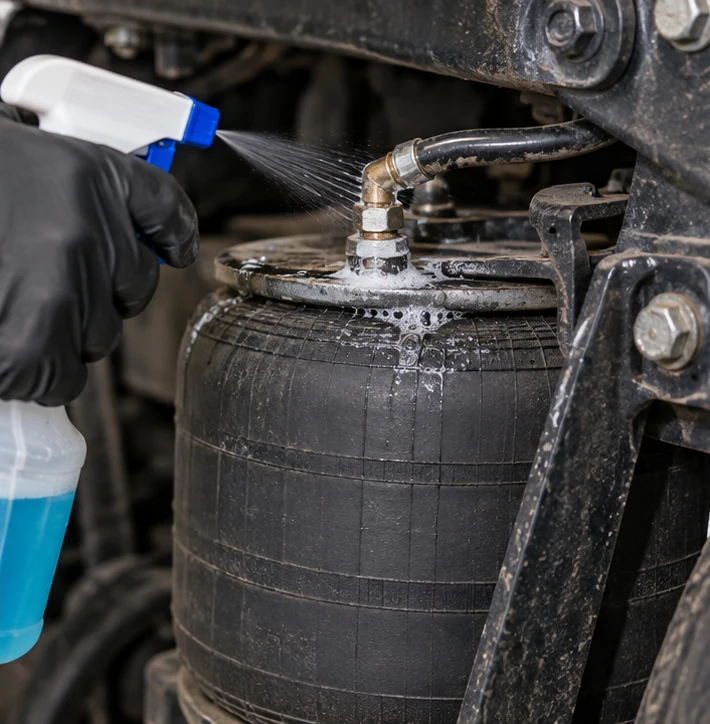
A short release of air can be normal when a height-control valve adjusts the suspension after loading, unloading, coupling, or a change in vehicle position. Continuous hissing is different. It may indicate a leak in an air spring, fitting, hose, valve, or air-suspension accessory.
Air springs flex thousands of times during normal operation. Over time, rubber can crack, mounting surfaces can corrode, and debris can damage the flexible material. A leak may only appear at a certain ride height or when the suspension is twisted on uneven ground.
A leaking line or fitting can also create an intermittent sound. The suspension may hold air while the truck is parked straight but leak during a turn when the line moves. A faulty height-control valve may continue adding or exhausting air instead of stabilizing the vehicle at the correct height.
Watch for a tractor or trailer that leans, settles rapidly after shutdown, takes too long to reach ride height, or causes the air compressor to cycle more frequently. These symptoms help separate a suspension leak from a normal adjustment.
Because the suspension and brakes can share the vehicle’s compressed-air supply, a large suspension leak may increase compressor workload and contribute to low system pressure. Never ignore a low-air warning simply because you believe the leak is limited to the suspension.
Rattling Often Comes From Shocks or Mounting Hardware
A light metallic rattle over small bumps may come from loose mounting hardware, worn shock-absorber bushings, broken brackets, or contact between components that should have clearance.
Shock absorbers control suspension movement after the truck encounters a bump. They do not normally support the vehicle’s weight, but they prevent the suspension from continuing to bounce. If a shock loses internal resistance or separates at a mount, the axle can move more aggressively and the shock itself may rattle.
Look for damaged shock bushings, loose fasteners, dents, broken mounts, or signs that the shock has been contacting another part. A light film of fluid does not always mean immediate failure, but heavy leakage combined with poor ride control or visible damage requires attention.
The cause may also be outside the suspension. Loose battery-box covers, exhaust shields, steps, fairings, mud-flap brackets, and storage compartments can produce rattles that seem to come from the chassis. A systematic inspection should include anything attached near the noisy area.
Suspension manufacturers publish model-specific maintenance procedures and inspection intervals. For example, Hendrickson provides a collection of technical publications and preventive-maintenance resources for its truck and trailer systems. The correct inspection and torque procedures depend on the exact suspension model.
Banging May Mean the Suspension Is Bottoming Out
A hard bang after hitting a dip or bump may mean that the suspension has reached the limit of its travel. This is often described as bottoming out. It can happen when air pressure is insufficient, ride height is incorrect, the truck is overloaded, a shock absorber has failed, or an air spring is damaged.
Operating an air suspension at the wrong ride height changes the relationship between the axle, frame, driveline, shocks, and air springs. If the suspension sits too low, components may strike the frame or bump stops. If it sits too high, shocks and air springs may become overextended.
A height-control valve problem can affect one axle or an entire suspension group. The valve’s linkage may be bent, disconnected, incorrectly adjusted, or damaged. However, drivers should not adjust the valve simply to make the truck appear level. The manufacturer’s ride-height measurement must be used because an incorrect adjustment can create driveline angles and suspension stress.
Overloading can produce similar symptoms. A suspension that works normally with an empty trailer may bottom out after freight is added. Confirm the actual axle weights rather than judging the load only by its total weight or the appearance of the vehicle.
A single severe bang should still be investigated if it follows contact with a pothole, curb, road debris, or dock structure. The impact may have damaged a spring, shock, airbag, wheel, tire, or axle-positioning part.
Popping During Turns Can Point to Shifting Components
A popping sound that appears when entering a driveway, making a tight turn, or twisting across uneven ground may be caused by suspension components shifting under side load. Worn bushings, loose fasteners, damaged spring hardware, or an axle-positioning problem can produce this type of noise.
The steering system can create similar symptoms. Tie-rod ends, drag links, steering joints, kingpins, and steering-gear mounts are close enough to the front suspension that the source may be difficult to distinguish from the driver’s seat.
On tractors with multiple rear axles, some tire scrub and driveline loading can occur during very tight turns. However, a sharp pop, repeated clunk, or sensation of movement beneath the truck should not be dismissed as normal.
Note whether the sound happens while the truck is moving or while the steering wheel is turned with the vehicle stationary. Also pay attention to changes in steering effort, wheel position, or the truck’s ability to track straight.
If the sound appears after suspension repairs, axle alignment, or tire replacement, have the work inspected. A fastener may not have been tightened correctly, or a component may have settled and require a manufacturer-specified follow-up inspection.
Grinding May Not Be the Suspension at All
Grinding is one of the more serious noises because it often means that rotating parts are making contact. Wheel bearings, brakes, driveline components, tires, and damaged wheel-end parts can all produce sounds that travel through the suspension.
A wheel bearing problem may create grinding, humming, or growling that changes with road speed or cornering. Brake components may scrape or grind during application. A damaged tire can rub against the frame, suspension, mud flap, or another tire in a dual assembly.
The suspension itself can contribute if a broken or displaced component allows unintended contact. A shifted axle, collapsed air spring, broken leaf spring, or incorrect ride height can move the tire or driveline away from its intended position.
Stop and inspect the vehicle if grinding is accompanied by heat, smoke, a burning smell, steering changes, braking problems, or severe vibration. Do not touch a suspected wheel end or brake assembly with a bare hand because it may be extremely hot.
Grinding should not be handled by turning up the radio and waiting for the next scheduled service. A wheel-end or brake failure can become dangerous with little additional warning.
A Broken or Shifted Spring Can Produce Several Different Sounds
Leaf springs can crack, break, shift, or become separated from their mounting position. Depending on the failure, the driver may hear squeaking, clunking, popping, scraping, or banging.
A broken leaf may remain partially held in place, making the damage difficult to see during a quick walk-around. It can also move outward and contact a tire or another component. The truck may lean, sit lower on one side, or handle differently under load.
Inspect the visible spring leaves, hangers, shackles, U-bolts, and mounting points. Look for missing pieces, unusual gaps, shiny contact marks, fresh rust around a crack, or a spring that is no longer aligned with the others.
Never attempt to reposition a spring by striking it or driving the truck in the hope that it will move back into place. Suspension springs store significant energy, and damaged components can shift unexpectedly.
The FMCSA’s Commercial Driver’s License Manual includes suspension components as part of the vehicle inspection process. Drivers should be able to recognize cracked or broken springs, damaged mounts, leaking shocks, and other visible defects before starting a trip.
The Cab Suspension May Be the Actual Source
Many highway tractors use a separate cab air suspension to isolate the driver from chassis movement. Its airbags, shocks, bushings, leveling valve, and mounts can create noise even when the axle suspension is operating correctly.
A cab-suspension problem may be most noticeable beneath or behind the driver’s seat. The cab can squeak as it moves, knock when crossing a bump, or lean if an airbag loses pressure. Worn cab mounts may also allow more movement during braking and acceleration.
Items inside the cab can imitate suspension noise. Seat bases, sleeper cabinets, refrigerator mounts, interior panels, and storage compartments may rattle or knock as the cab moves.
A technician can inspect the cab suspension separately from the chassis suspension. Reporting that the noise seems to come from directly beneath the seat or changes with cab movement can make diagnosis faster.
How to Describe Suspension Noise to a Mechanic
A useful repair report provides more than “the suspension is noisy.” Describe the sound as accurately as possible and explain when it occurs.
State whether the truck was loaded or empty, whether a trailer was attached, and whether the noise came from the front, rear, left, or right side. Mention the road speed, brake application, steering position, and type of road surface. If the noise changes after the suspension reaches normal ride height, include that information as well.
A safe audio or video recording may help, but never hold a phone while driving or place yourself near moving components. A second person can record the sound from inside the cab while the driver remains focused on operating the vehicle.
Do not assume that a louder noise always represents a more serious problem. A small loose shield may be extremely noisy, while a cracked structural component may produce only an occasional click. Inspection is still necessary.
When Should You Stop Driving?
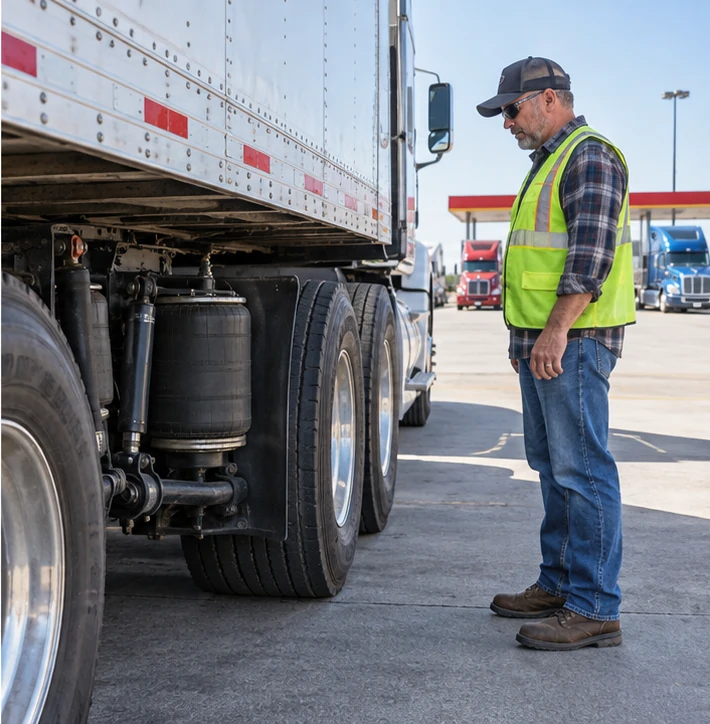
Not every suspension noise requires an emergency roadside stop. However, you should stop in a safe location if the noise is accompanied by leaning, sudden ride-height loss, tire contact, steering changes, unstable handling, severe vibration, visible broken parts, or an air-pressure warning.
A truck should not continue operating with a broken spring, damaged axle-positioning component, loose or missing critical hardware, collapsed air suspension, or any condition that affects safe control.
After stopping, park on firm and level ground when possible, apply the parking brakes, and follow the company’s procedures. Inspect only from a safe position. Do not place any part of your body beneath a vehicle supported only by its suspension, and do not loosen pressurized or load-bearing components.
Drivers are required to be satisfied that the vehicle is in safe operating condition before driving under 49 CFR § 396.13. If you cannot determine whether the truck is safe, contact fleet maintenance or a qualified roadside technician.
How Regular Inspections Help Prevent Suspension Noise
Suspension problems are easier to repair before worn parts damage neighboring components. During pre-trip and post-trip inspections, check the truck’s ride height, overall level, visible air springs, shocks, leaf springs, brackets, and mounting hardware.
Look for air leaks, cracked rubber, polished contact areas, missing fasteners, broken welds, fluid leakage, shifted parts, and uneven tire wear. Tire wear can reveal alignment or axle-positioning problems that may not yet produce obvious handling symptoms.
Maintenance personnel should follow the suspension manufacturer’s inspection, torque, lubrication, and replacement procedures. Torque values and service intervals should never be guessed because they vary by component and application. The available SAF-Holland suspension service literature is one example of the model-specific information technicians use when maintaining commercial-truck and trailer suspensions.
Keeping the suspension in good condition does more than eliminate noise. It protects tires, improves ride control, reduces stress on the frame and cargo, and helps the brakes maintain consistent contact with the road.
Frequently Asked Questions
Is It Normal for Air Suspension to Make Noise?
A brief hiss when the height-control valve adds or releases air can be normal. Continuous hissing, rapid air loss, frequent compressor cycling, or a suspension that will not maintain ride height suggests a leak or valve problem.
Why Does My Truck Clunk When I Start Moving?
The change from rest to acceleration places force on the suspension, driveline, fifth wheel, and cab mounts. Worn bushings, loose axle-positioning parts, shock mounts, driveline components, or fifth-wheel play can create a clunk.
Why Does the Suspension Squeak More in Cold Weather?
Low temperatures can make rubber bushings less flexible and may expose wear that is less noticeable in warm conditions. Moisture, ice, and road contamination can also affect suspension movement. The seasonal change in sound does not eliminate the need for inspection.
Can Bad Shock Absorbers Make a Semi-Truck Noisy?
Yes. Worn bushings or loose shock mounts can rattle or clunk. A failed shock may also allow excessive axle movement, causing other components to reach their travel limits or strike surrounding parts.
Can Suspension Problems Cause Uneven Tire Wear?
Yes. Worn bushings, loose components, incorrect ride height, or axle-alignment problems can change how the tires contact the road. Uneven wear should be investigated instead of corrected only by replacing the tires.
Final Thoughts
A noisy truck suspension may be caused by worn bushings, loose hardware, leaking air springs, damaged shocks, broken leaf springs, incorrect ride height, or shifting axle components. The sound may also come from a wheel end, brake, fifth wheel, driveline, cab mount, or another part attached to the chassis.
The most useful clues are the type of noise and the conditions under which it appears. A squeak suggests friction, a clunk suggests movement, a hiss suggests escaping air, and a grinding sound may involve rotating components. These clues can guide an inspection, but they should not be treated as a complete diagnosis.
Pay attention whenever your truck begins making a new sound. Report it accurately and have the suspension inspected before the condition affects tires, alignment, braking, or vehicle control. Finding the cause early is usually safer, faster, and less expensive than waiting for the noisy component to fail on the road.
