
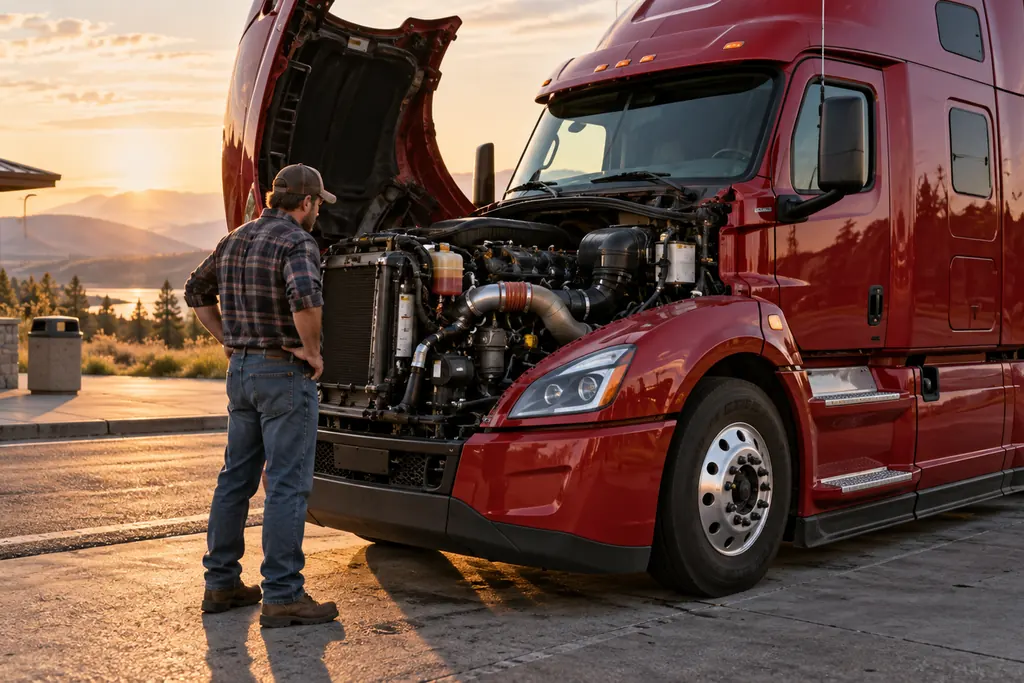
A loaded semi-truck climbing a long grade works much harder than the same truck cruising on level ground. On a hot day, the coolant temperature may rise faster than a driver expects. A warning light, climbing gauge, or loss of engine power can then make the next few minutes feel urgent. The right response is to protect the truck and find a safe place to stop, not to guess which part of the cooling system has failed while traffic is still moving around you.
Overheating has several possible causes. Some are visible during a careful inspection; others require shop equipment and a trained technician. This guide explains what a driver can observe, what warning messages may mean, and how to communicate useful details to maintenance without taking unsafe shortcuts.
Understand what the warning is telling you
A coolant-temperature warning is a condition, not a diagnosis. Depending on the truck, the dashboard may show a caution message, a red stop message, a power reduction, or more than one of these. The Volvo Trucks Driver Guide describes protective responses to high coolant temperature and low coolant level, including reduced power and a stop notification when temperature is too high. Your own truck’s manual and displayed instruction govern the immediate response; thresholds and messages differ among models and engines.
Do not assume a warning is harmless because it disappears after a hill. The temperature may fall when the load on the engine falls, even though a leak, weak fan, restricted radiator, or other fault remains. Note the road speed, outside temperature, grade, load, and whether the warning returned. Those details help the maintenance team understand the pattern and reduce the chance of sending the truck back out with the underlying issue unresolved.
Make the first decision about safety, not repair
When the gauge rises or a warning appears, ease the engine load as conditions allow and follow the vehicle’s instructions. If the truck directs you to stop, move to a safe legal location as soon as it can be done without creating another hazard. Do not stop in a live lane to inspect under the hood. Signal early, leave enough room for traffic, and use a truck-suitable exit or parking area if the vehicle can reach one safely. If it cannot, use the carrier’s roadside emergency procedure.
Once parked, secure the truck and contact dispatch or maintenance. Give them the exact warning text or icon, any change in engine power, whether steam or coolant is visible, and your location. A photo of the dashboard taken while safely parked is often more useful than a vague report that the truck “ran hot.” Avoid repeated restarts simply to see if the warning clears; the system may be protecting the engine from damage.

Do not open a hot cooling system
Cooling systems operate under pressure. Removing a radiator or expansion-tank cap while the system is hot can release scalding coolant and steam. A Cummins maintenance guide instructs personnel to shut down the engine and wait for coolant temperature to drop before removing the pressure cap. Drivers should follow the vehicle and engine manufacturer’s exact procedure and ask qualified service personnel when uncertain. The safest roadside observation may be from outside the engine bay, with the hood kept closed until it is safe to inspect.
Never pour cold water onto a hot engine or reach toward a leak, hose, belt, or fan while components are moving. If there is visible coolant beneath the truck, note its location and approximate amount without crawling under the vehicle near traffic. Keep bystanders away from a steaming engine compartment and let maintenance determine when inspection can begin.
Common causes a technician may investigate
A low coolant level can result from a hose leak, loose connection, failed cap, radiator damage, or an internal engine problem. A low level reduces the system’s ability to move heat away from the engine. But topping up the tank without finding the cause is not a reliable fix, especially if the level drops again. The coolant must also meet the engine maker’s specification. Cummins explains that coolant chemistry and maintenance contribute to corrosion protection and heat transfer, not merely freeze protection.
Airflow problems are another possibility. Dirt, insects, or road debris can restrict the radiator or charge-air cooler. A cooling fan that does not engage properly, a damaged belt on a configuration that uses one, or a malfunctioning fan-control system can make temperature climb when the truck is pulling hard or moving slowly. A thermostat or water pump problem can also restrict coolant circulation. None of these can be confirmed from a dashboard light alone; a technician needs to inspect the actual truck.
Operating conditions matter too. A heavy load, steep grade, prolonged low-speed work, high ambient temperature, and a clogged cooling package can combine to expose a weak component that seemed normal on an easier route. Tell maintenance when the temperature rose and when it returned toward normal. “It overheated halfway up a long grade with a loaded trailer” is much more useful than “it got hot once.”
What to look for after the system is safe to inspect
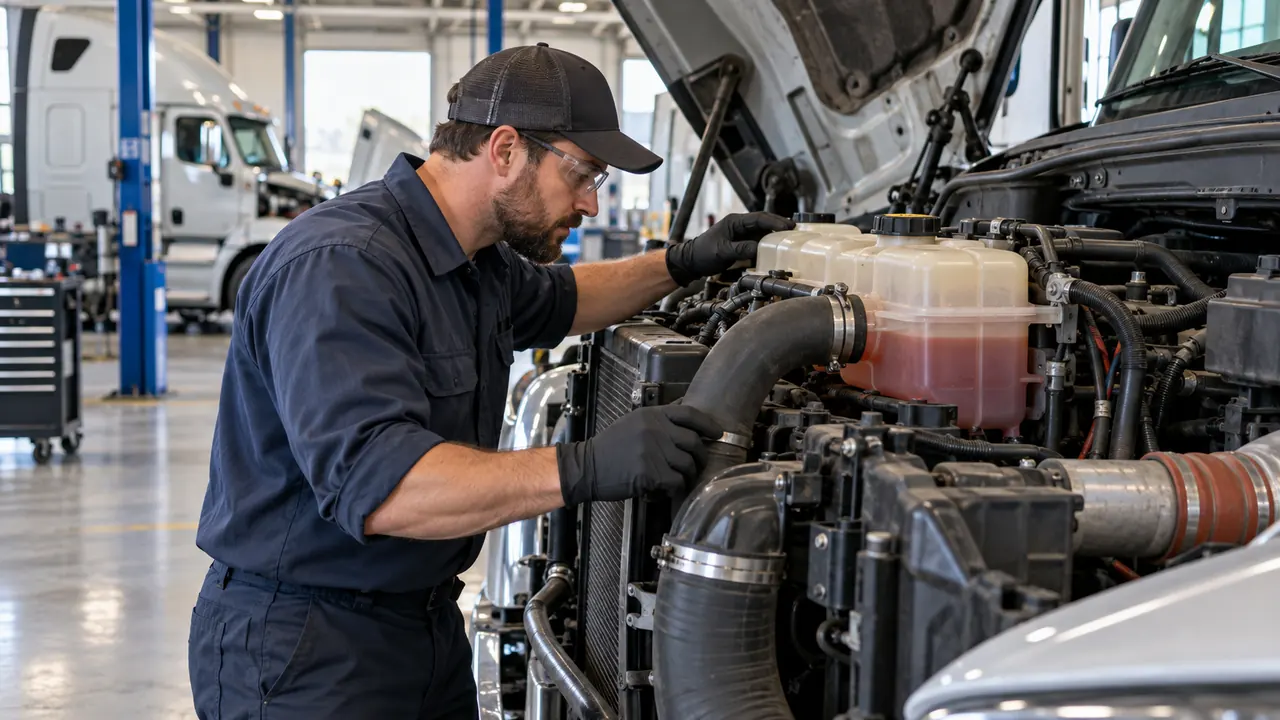
When the truck has cooled and the carrier authorizes a visual check, look for signs that can be observed without touching pressurized or moving parts: wet areas around hoses, coolant residue near the radiator or reservoir, a puddle under the truck, a loose visible hose, or debris blocking airflow. Use a flashlight and take photographs. Do not put hands near a fan, even if the engine is off; some fans may operate automatically or components may still be hot.
A low coolant level after a warning is important information, but it does not by itself tell you where the coolant went. If the truck was driven hot, service personnel may need to check for pressure loss and additional damage before clearing it for a loaded trip. A driver should not be expected to diagnose that at a rest area. Accurate observations and the truck’s fault information are the useful handoff.
Decide whether the trip can continue
Do not judge roadworthiness only by the fact that the engine restarts. Confirm with qualified maintenance that the cause has been identified, the warning is addressed, and the truck can safely carry the current load. If a repair is needed, update dispatch and the customer with a realistic delay. A schedule can be changed; engine damage or a roadside breakdown may be much harder to recover from.
If the problem turns out to be minor and maintenance clears the truck, monitor the gauge and messages closely on the next leg. Plan a suitable stop where the vehicle can be checked again. Record what happened, including the repair, coolant added if any, and whether the warning returned. That history is valuable if a recurring fault appears on another hot day or grade.
Make cooling-system checks part of the routine
Before a long run, review the truck’s fluid-level and leak checks as directed by the manufacturer and fleet. Look through the grille for debris, check for signs of coolant loss beneath the vehicle, and report hoses or belts that appear damaged. Keep the cooling package clean through the maintenance schedule rather than waiting for a warning light. A rising temperature trend noticed during a safe stop is a reason to ask maintenance a question before the next mountain crossing.
The practical rule is simple: treat a heat warning as a request for a decision, not as a puzzle to solve while driving. Follow the dashboard instruction, stop safely when directed, keep clear of a hot pressurized system, and give the technician the information needed to find the real cause. Those steps protect the driver, the load, and the engine far better than trying to squeeze the original schedule out of a truck that is asking for help.
